

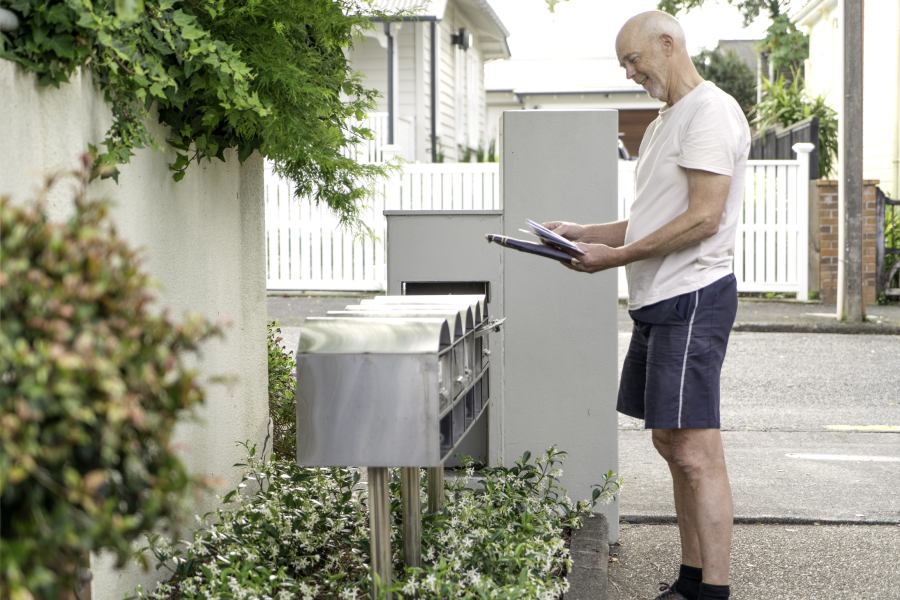
In an era of digital fatigue, physical mail is gaining renewed relevance as a communication channel.
For years, digital channels were positioned as faster, cheaper, and more efficient. But today, the opposite is starting to feel true. Every day your customers receive an overload of digital communications. Whether it’s through social media or our inbox, it’s hard to escape the thousands of messages competing for our attention. In this oversaturated environment, communications are easily missed, filtered or ignored.
Beyond the overflowing inbox, email now carries an added risk: rising scams and phishing attempts. Your customers can’t assume every message is genuine and trustworthy.
At the same time, physical mail is quietly experiencing a resurgence. A comprehensive research study, completed by The Source in Australia and New Zealand, shows that most New Zealanders check their physical mailbox several times a week. People open letters from organisations they know and trust.
For organisations needing certainty, attention, and trust, the mailbox deserves a serious place in the channel mix.
Trust: why the letterbox outperforms the inbox
When it comes to sensitive or important communications, trust is everything and this is where physical mail has a clear advantage.
The research study completed by The Source also revealed that 43% of people trust the information received in their mailbox. Only 35% of respondents said they trusted messages sent to their inbox.
Part of the reason why the mailbox in a trusted option is because people often report getting less spam or unwanted communication. While inboxes are filled with promotional emails, phishing attempts, and unread messages, the physical mailbox remains comparatively protected.
Low digital risk, high confidence
The pace of digital change has forced people into a permanent state of vigilance. Too often, we hear stories of people scammed out of their savings, repeating the same painful sentiment: “I never thought this would happen to me.”
Email, SMS, and app-based communication all carry an inherent level of vulnerability, from phishing and spoofing to account takeovers and mass-targeted cyberattacks. Even legitimate messages can be tampered with or intercepted before reaching the intended recipient.
Physical mail removes many of these risks. A printed letter is far more difficult to fake at scale, and it can’t be hacked, forwarded, or duplicated with a single click.
The mailbox is a low-risk, high-confidence environment where important information can be delivered with confidence.
Physical mail receives deliberate, focused engagement
People are far more likely to concentrate on printed material than digital content. A letter or promotional material in hand invites focus: you hold it, you read it, and you give it a moment of uninterrupted attention.
In the research study conducted in Australia and New Zealand, 54% of respondents said that they concentrate more on promotional material when it’s printed and in their hands.
A Canadian Study titled ‘A bias for action’ concluded that direct mail required 21% less cognitive effort to process and elicits a higher brand recall. They found that participants processed direct mail quicker and were more likely to take action.
Physical mail also benefits from longer dwell time. Instead of disappearing into an inbox, or getting filtered by email servers, it can remain visible in the home for a several days.
Reaching everyone without barriers
Access to digital channels should not be a given. There’s still a part of the population that has low digital literacy and might not have access to computers or smartphones. The barrier could be even higher for communications that can only be delivered through a specific app, like a banking app, to remain secure.
Printed letters have no technological barriers. They don’t require a smartphone, an internet connection, or an understanding of digital tools. There are no passwords to reset, links to verify, or security steps to complete.
For many people – including older adults, rural communities, non-digital users, and those with accessibility needs – the mailbox remains the simplest and most reliable way to receive essential information. Mail provides universal access in a way that digital channels simply can’t replicate.
Choosing the right channel
Not all communication channels are equal, and not all of them work for every audience, every message or every moment. The question is not just ‘digital or print?’, but ‘what’s the right mix to reach my audience in a timely and relevant way?’.
Physical mail stands out for moments where trust, clarity, or guaranteed attention matter most. Digital channels excel when speed, immediacy, or interactive functionality is required.
Truly understanding your clients includes knowing the channels they trust and the moments they’re most receptive. An integrated approach to customer communications reduces risk and increases engagement.
Rediscovering the power of the mailbox
In a world that’s pushing us toward all-digital interactions, the mailbox is quietly holding its ground. It cuts through noise, avoids digital risk, and reaches people in a way that feels intentional and trustworthy.
For organisations, this isn’t about choosing old over new. It’s about choosing the channel that gets the job done. In any channel, an unopened, unread message creates a cost without providing any value.
With multi-channel capabilities, secure workflows, and reliable delivery at scale, Dataprint gives organisations the confidence that their communications reach the right hands, at the right time.